Welcome to Gardeners Way
Gardening Spring Flower Article
![]()
This is a selection made from among articles on Gardening Spring Flower. For a permanent link to this article, or to bookmark it for future reading, click here.
Flower Gardening in Containers
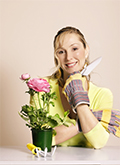
from:Before you start your flower gardening in containers, ask yourself a few questions. Are you looking for one large pot in which to plant a variety of mixed flowers or are you thinking of planting individual flowers in many smaller individual containers? Do you want to be able to rearrange your container garden on a whim if you get tired of the same old arrangement? Do you want to throw in some hanging plants instead of just having stationary containers? What is your purpose in undertaking flower gardening in containers? What kind of visual expression are you trying to achieve? Do you want small plants or large ones?
It’s true that almost anything will grow in a container, but if going for the mixed container option, you must be very careful in choosing what plants to house together. For example, strawberry plants are not that aggressive when it comes to competing for water and nutrients and may do very poorly in a container with a more aggressive plant. As a general rule, you should choose plants that have similar characteristics and needs when putting more than one plant in the same container. And make sure each plant has the space that it needs.
While almost every flower will adapt to growing in a container, you will need to provide it with the light, soil, water, nutrients, and care that it requires. You may need to add a grow light (which you can purchase at your local garden supply store) for flowers needing full sun, while flowers that only need indirect light will do well in a window space. Do not use plain garden soil when flower gardening in containers because it will eventually turn into compacted rock-hard soil through which roots cannot grow. Sterilized potting mix, prepared potting soil, or soil-less potting mixture, which can be purchased at any nursery, are all viable options. If you feel that the prepared mixture can do with a little extra organic matter, add some peat moss. Some plants, like orchids and African violets, will require special potting mixtures, so make sure you understand the individual needs of your container garden inhabitants.
Obviously, as enthusiastic as you are now about your new flower gardening in containers hobby, be realistic about the amount of time you will actually be able to spend on caring for your container garden. African violets are relatively easy to grow, but exotic plants like the bird of paradise are quite high maintenance.
Once you’re sure you can meet your plants’ needs, get started on designing your container flower garden. Don’t consider the containers as just a place to plant flowers, but as part of the visual appeal of your new garden. Try clustering containers together, or separating them into strategic locations. Place containers on wooden benches or on other, upside-down containers. Line a bland stairway with small containers of colorful flowers, or brighten up your window with window boxes.
To start, place a layer of rocks or chipped wood at the bottom of your container (again, this will help with drainage and may be a better solution than drainage holes, which may cause soil loss). Then add your soil mixture (with organic matter) and a good fertilizer. Don’t fill the container to the top as of yet; stop at the level where you’d like the roots of your plant to sit. Take your plant and sit the root ball on the soil; then add more soil mixture to fill in around the roots. Stop at about one inch from the top of the container. Add a plentiful amount of water to the container immediately after planting. To keep the soil from drying out, you can add pebbles, or dried moss around the base of the plant.
Good plants to use in your flower gardening in containers hobby can be tender perennials and non-hardy plants; things like asters, lantana, coleus, and delicate bulbs can work well. Annuals are wonderful for container gardens because you don’t have to worry about winter conditions and they provide instant, consistent color.
As far as maintenance, since the soil in containers dries out quickly (because it’s lighter and fast-draining), you’ll need to water container gardens more watering. They also require more feeding. Since plants don’t grow naturally in containers, you’ll need to provide them with all their needs. If you take care of them, though, container gardens will provide you with amazing displays of beauty and nature at your fingertips; they can brighten up your living space and lift your spirits.
Gardening Spring Flower News
Gardening: Plant flower bulbs right to avoid spring no-shows
There are the occasional no-shows, of course -- those that fail to flower and deliver the first burst of color in early spring. Here's why some bulbs fall short, and what you can do about it.
Read more...Gardening classes under way
January's unusually mild weather has some local folks already thinking spring and looking forward to a new gardening season.
Read more...Helen Yemm's Thorny problems: north-facing flower beds
Helen Yemm answers your gardening questions on white-stemmed birches, mice, and north-facing "flower" beds.
Read more...Gardening: Hibiscus has tremendous flower variations
Hibiscus plants are blooming profusely all over Marco right now. This plant seems to love the cold weather. Perhaps it is because the severe cold helps control some of the insects that constantly cause the blossoms to drop. Whatever the reason enjoy the beauty of these glorious flowers.
Read more...Ag Center to host series on winter gardening
A winter gardening series will begin Feb. 13 and continue Feb. 20 and March 5 from 7 to 9 p.m. at the Berks County Agricultural Center, Bern Township.
Read more...